
Best WordPress SEO Plugins in 2026 (Compared & Ranked)
WordPress powers a huge share of websites on the internet — but running WordPress alone doesn’t guarantee traffic. Ranking on Google in 2026 means handling on-page SEO, technical SEO, Core Web Vitals, schema markup, and increasingly, visibility in AI-driven search experiences like Google’s Search Generative Experience and AI Overviews.
The right WordPress SEO plugin handles most of this work directly from your dashboard, without needing custom code or hiring a developer. But with dozens of options promising top rankings, picking the right one is confusing. Some are bloated. Some hide essential features behind a paywall. Some slow your site down more than they help it.
In this guide, we break down the best WordPress SEO plugins of 2026 — what each one does well, where it falls short, real pricing, and which type of site each one fits best.
Why You Need an SEO Plugin on WordPress
WordPress, by default, doesn’t generate XML sitemaps optimized for search engines, doesn’t add structured data (schema) to your pages, and doesn’t give you any feedback on whether a post is actually optimized for its target keyword. An SEO plugin fills these gaps. Specifically, it helps with:
- On-page optimization — keyword usage, meta titles, meta descriptions, heading structure
- Technical SEO — XML sitemaps, canonical URLs, robots.txt control, redirect management
- Structured data (schema) — helps Google understand your content type (article, product, FAQ, review, etc.) and can unlock rich snippets in search results
- Site health — 404 monitoring, broken link detection, duplicate content warnings
- Integrations — direct connection to Google Search Console and Google Analytics inside your dashboard
- AI search readiness — newer plugins now support llms.txt and structured formatting so AI tools like ChatGPT and Perplexity can cite your content accurately
Without one of these plugins, you’d need to manually edit theme files or hire a developer for every small SEO change — which isn’t practical for most site owners.
How We Compared These Plugins
Four factors determine whether a plugin actually helps your rankings, not just how many settings it has:
- Features — focus keyword support, schema coverage, redirect manager, 404 monitoring, analytics integration
- Performance — how much load the plugin adds to your site, and its effect on Core Web Vitals
- Pricing & value — real annual cost, especially across multiple sites, and what the free tier actually unlocks
- Ease of setup — how quickly a non-technical user can reach a properly configured state
The Best WordPress SEO Plugins of 2026
1. Rank Math — Best Overall / Best Free Plugin
Rank Math has become the default recommendation for most WordPress sites in 2026. Its strategy from day one was to include features in the free tier that competitors charge for — and that value proposition has held up.
What’s included in the free version:
- Redirect manager
- 404 error monitoring
- Google Search Console integration inside WordPress
- 18+ schema types with a visual schema builder
- Unlimited focus keywords per post
- 100-point real-time SEO scoring
- llms.txt support for AI crawlers
Pros:
- Most generous free tier of any major plugin
- Modular setup — only activate the modules you actually need, keeping the plugin light
- Strong AI content suggestions for SGE and AI Overviews visibility
Cons:
- The sheer number of settings can feel overwhelming for absolute beginners
- Some advanced automation features are Pro-only
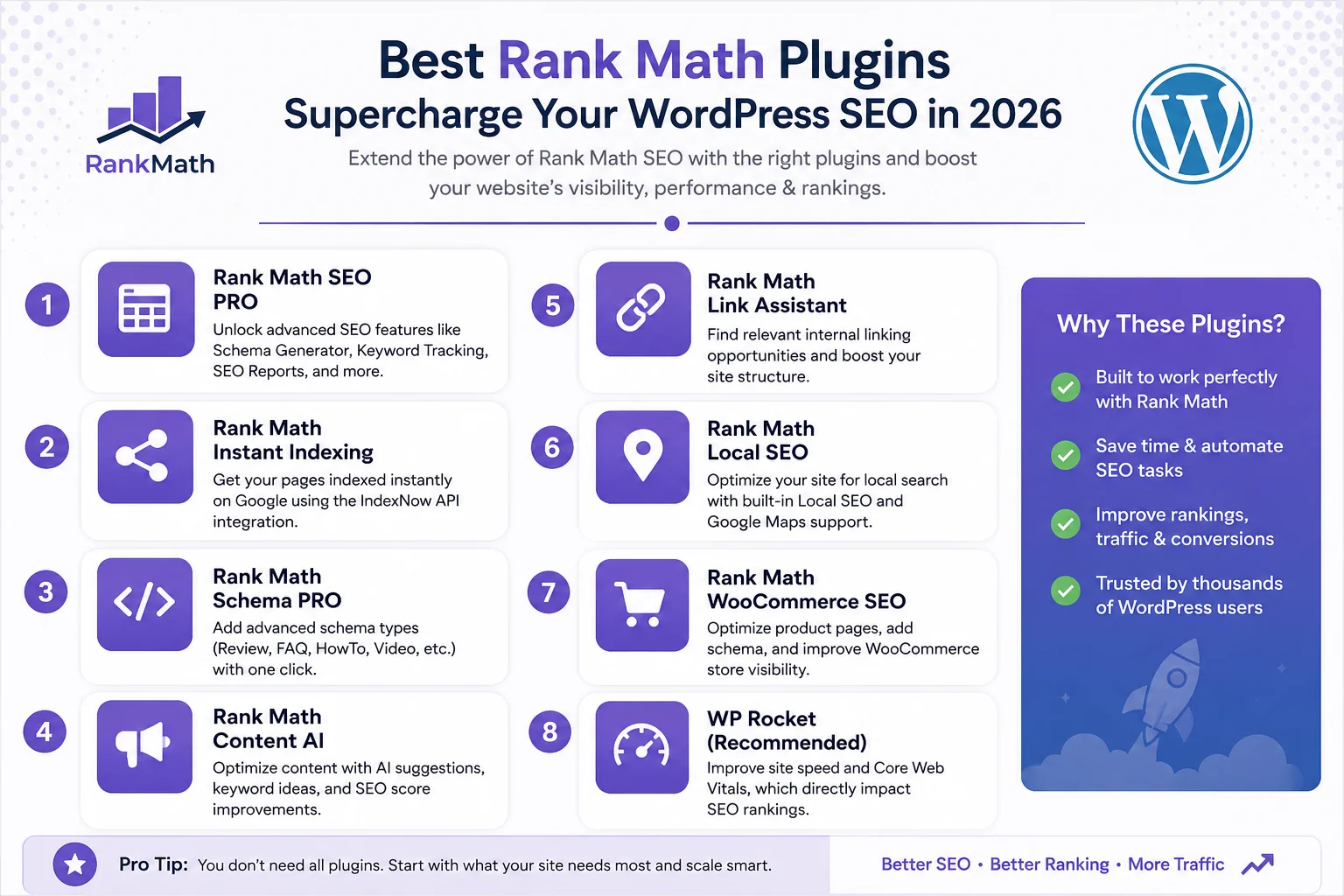
Best for: Bloggers, small businesses, and anyone who wants advanced features without paying. Pricing: Free tier covers most needs. Pro is around $59/year for unlimited personal sites.
2. Yoast SEO — Best for Beginners
Yoast SEO has been running since 2008 and remains the most widely installed SEO plugin in the WordPress ecosystem, with well over 13 million active installs. Its main strength is guidance — it walks you through optimizing each post as you write it, using a simple traffic-light (red/orange/green) system.
What’s included:
- Real-time content and keyword analysis while writing
- Readability checker — flags passive voice, long sentences, poor heading structure
- XML sitemap generation
- Schema.org integration for rich results
- Open Graph tags for better social media previews
Pros:
- The most familiar, well-documented interface — easiest to train a team on
- Readability analysis genuinely improves writing quality, not just SEO
- Consistently updated to match Google’s Helpful Content and E-E-A-T guidance
Cons:
- Priced per site, which gets expensive fast if you manage several websites
- Redirect management and deeper schema options require the Premium upgrade
- Fewer free features compared to Rank Math or SEOPress
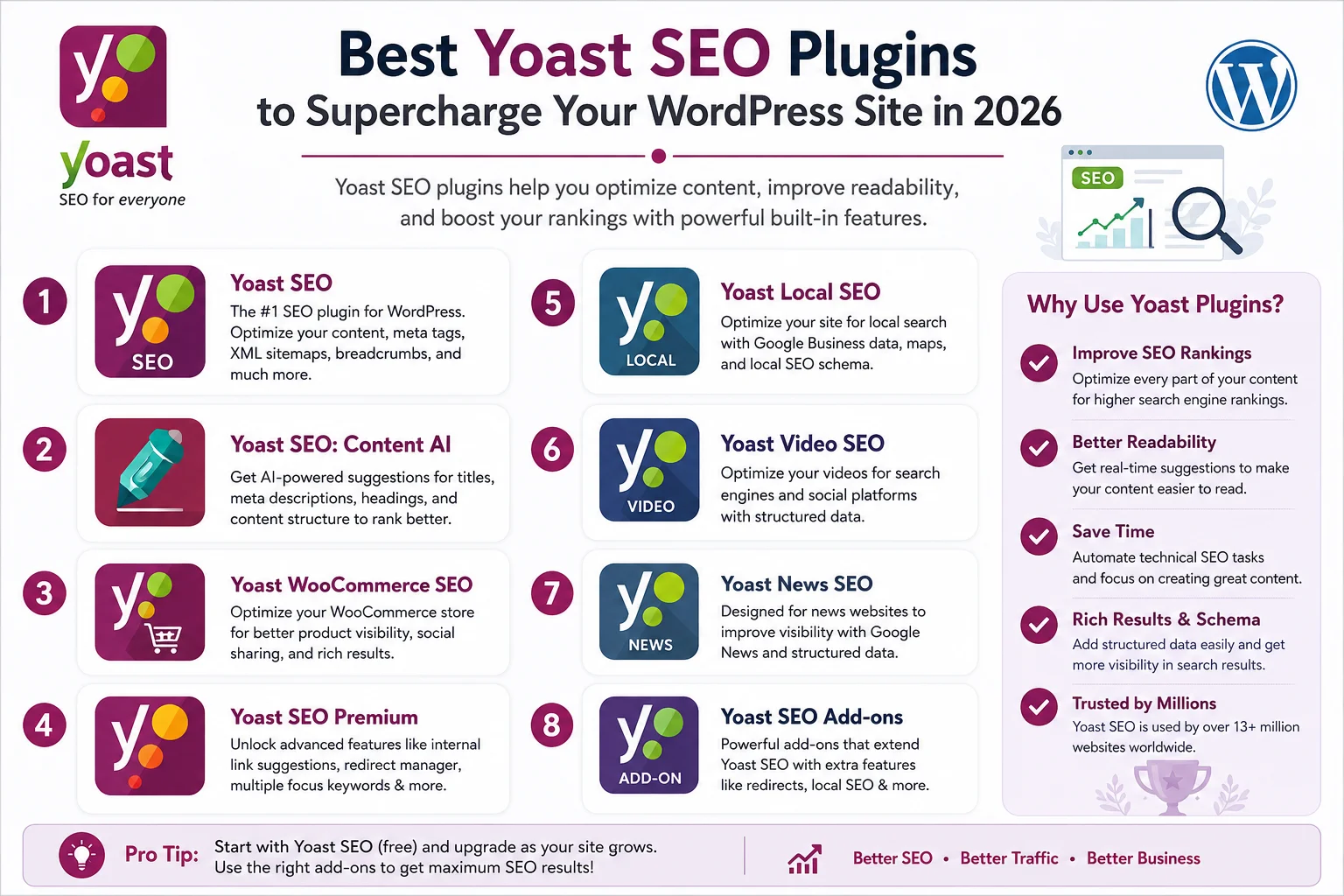
Best for: Beginners, solo bloggers, and teams who want guided, step-by-step SEO feedback. Pricing: Premium is around $99–118/year per site — so 5 sites can cost close to $500-600/year.
3. All in One SEO (AIOSEO) — Best for WooCommerce & Agencies
AIOSEO combines a clean, beginner-friendly dashboard with genuinely advanced tools — its TruSEO scoring system, Link Assistant for internal linking, and a built-in Redirection Manager save real time on larger sites.
What’s included:
- TruSEO on-page scoring (0–100) with a content highlighter
- Smart SEO Setup Wizard — configures core settings in under 10 minutes
- AI Title & Meta Description Generator
- Strong native WooCommerce and Local SEO support
- Schema-rich snippets for products, FAQs, and posts
Pros:
- Best-in-class WooCommerce integration out of the box
- Multi-site pricing is far more competitive than Yoast at scale
- Clean dashboard that’s easy for non-technical clients to use
Cons:
- Slightly fewer unlimited free features compared to Rank Math
- Some users find the sheer feature set takes longer to fully configure
Best for: eCommerce stores and agencies managing multiple client websites. Pricing: Elite plan covers up to 100 sites for roughly $299/year — a major saving over per-site pricing models.
4. SEOPress — Best for Privacy & Performance
SEOPress has grown quickly by focusing on three things competitors often ignore: privacy, performance, and honest pricing. It’s completely GDPR-friendly, makes no outbound requests, and has zero ads or upsell banners inside the dashboard.
What’s included:
- Unlimited keywords and content analysis, even in the free version
- Advanced redirects and analytics (Pro)
- White-label mode and unlimited site licensing (Pro)
- Built-in llms.txt support for AI crawler visibility
- API access for building custom SEO dashboards (Pro)
Pros:
- One of the strongest free tiers available — most features aren’t locked behind a paywall
- Unlimited-site Pro pricing is dramatically cheaper than per-site models
- Lightweight, clean code with minimal server footprint
Cons:
- Interface takes slightly longer to master than Yoast or AIOSEO
- Fewer built-in AI content generation tools compared to Rank Math or AIOSEO
Best for: Developers and agencies who value clean code, privacy, and multi-site value. Pricing: Pro starts around $49/year, unlimited sites.
5. The SEO Framework — Best for Site Speed
If your top priority is raw performance, The SEO Framework is built specifically to add the least possible overhead. It auto-generates meta titles, descriptions, and sitemaps using sensible, content-based defaults — with zero ads, upsells, or nagging “SEO score” prompts.
What’s included:
- Auto-generated meta tags based on your actual content
- Built-in XML sitemap and canonical URL handling
- Unbranded, ad-free interface
- Modular extensions — add structured data or local SEO only if you need them
Pros:
- Lightest plugin on this list in terms of server impact
- Zero setup required to get sensible, working SEO defaults
- No nags, no upsells, no artificial “SEO score” gamification
Cons:
- Doesn’t offer step-by-step, prescriptive guidance like Yoast or Rank Math
- Fewer built-in AI or content-assistant features
Best for: Performance-sensitive sites where speed matters more than in-editor hand-holding. Pricing: Core plugin is free; advanced features available as paid extensions.
Quick Comparison Table
| Plugin | Best For | Free Tier | Starting Price |
|---|---|---|---|
| Rank Math | Overall / most free features | Excellent | $59/year (unlimited sites) |
| Yoast SEO | Beginners, guided writing | Good | ~$99–118/year per site |
| AIOSEO | WooCommerce, agencies | Good | ~$299/year (up to 100 sites) |
| SEOPress | Privacy, performance, multi-site | Excellent | $49/year (unlimited sites) |
| The SEO Framework | Site speed | Excellent | Free (core plugin) |
How to Choose the Right Plugin for Your Site
- Single blog, tight budget → Rank Math free tier or The SEO Framework
- Running a WooCommerce store → AIOSEO for its native product schema and Local SEO tools
- Managing multiple client sites → SEOPress or Rank Math for unlimited-site pricing
- New to SEO, want hand-holding → Yoast SEO for its guided, traffic-light system
- Speed is your top priority → The SEO Framework for minimal overhead
Common Mistakes to Avoid
- Running two SEO plugins at once. They conflict with each other — duplicate sitemaps, duplicate schema, and conflicting meta tags can actively hurt your rankings. Always deactivate and fully remove the old plugin before installing a new one.
- Skipping the site backup. Always back up your site (UpdraftPlus works well) before switching SEO plugins, in case settings don’t import cleanly.
- Ignoring page speed. An SEO plugin is only half the picture — pair it with a caching plugin like WP Rocket to actually improve Core Web Vitals scores, which factor into rankings.
- Not running a post-install audit. After switching plugins, run a full site crawl/audit to catch broken redirects or missing meta data early, before Google recrawls your site.
Frequently Asked Questions
Is Rank Math really better than Yoast in 2026?
For most sites, yes — Rank Math’s free tier includes features (redirect manager, schema builder, unlimited keywords) that Yoast charges for in its Premium plan. Yoast still wins on ease of use and guided writing feedback for absolute beginners.
Can I use more than one SEO plugin? No. Running multiple SEO plugins together causes conflicts — duplicate meta tags, conflicting sitemaps, and duplicate schema markup, which can hurt rankings instead of helping them.
Do these plugins help with AI search (ChatGPT, Perplexity, AI Overviews)?
Increasingly, yes. Rank Math and SEOPress both now support llms.txt, which helps AI crawlers understand and correctly cite your site’s structure and content.
Is a free SEO plugin enough for a small site?
For most small blogs and brochure sites, yes — Rank Math’s free tier or The SEO Framework cover sitemaps, meta tags, and basic schema without any paid upgrade.
Final Verdict
For most WordPress sites in 2026, Rank Math is the strongest overall pick thanks to its generous free tier and unlimited-site pricing. Yoast SEO remains the best choice for absolute beginners who want guided feedback. AIOSEO is the clear winner for WooCommerce stores and agencies, while SEOPress offers the best value for developers running multiple sites who care about privacy and clean code. If speed is your only concern, The SEO Framework adds the least overhead of any plugin on this list.
Whichever plugin you choose, the plugin itself is only a tool — consistent, well-structured content and a fast, mobile-friendly site still matter more than any single setting inside your SEO dashboard.