
Off Page SEO Ranking Factors: The Complete Guide to Building Website Authority
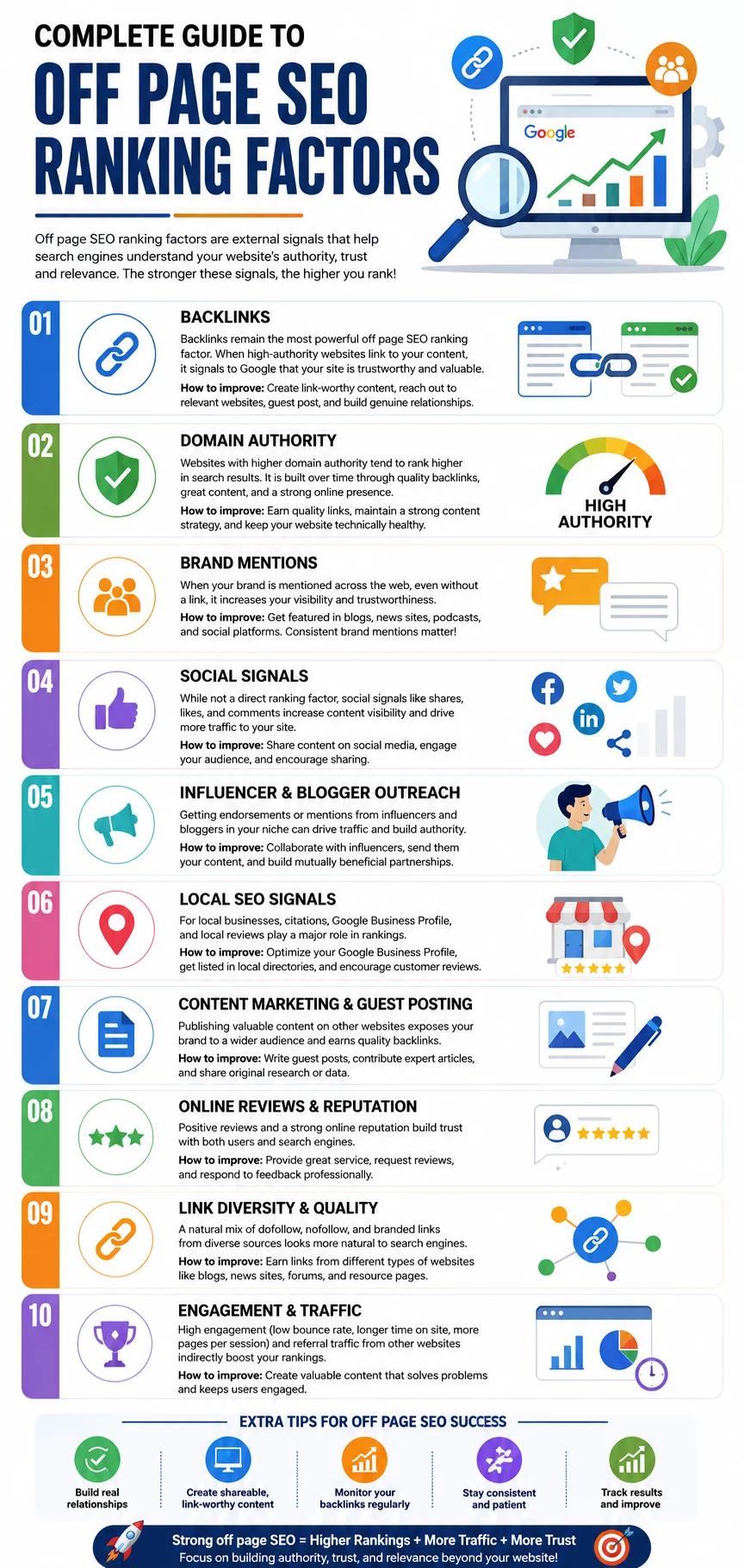
If you want your website to rank higher on Google, you need to understand off page SEO ranking factors. While on-page SEO focuses on what happens directly on your website — your content, headings, and internal links — off page SEO ranking factors are all about what happens outside your website that signals trust, authority, and relevance to search engines.
In this guide, we will break down every major off page SEO ranking factor, explain why it matters, and show you practical ways to improve each one. Whether you are new to SEO or looking to refine your strategy, understanding these off page SEO ranking factors will help you build a website that search engines trust and users love.
What Are Off Page SEO Ranking Factors?
Off page SEO ranking factors refer to all the actions taken outside of your own website that influence your position in search engine results pages (SERPs). Unlike on-page SEO, which you have direct control over, off page SEO ranking factors depend largely on how other websites, users, and platforms interact with and talk about your brand.
Search engines like Google use these off page SEO ranking factors to determine how trustworthy, authoritative, and popular a website is. Think of it like a reputation system: the more credible signals your website receives from external sources, the more likely search engines are to reward you with higher rankings.
Some of the most well-known off page SEO ranking factors include backlinks, social signals, brand mentions, online reviews, guest posting, and influencer collaborations. Each of these plays a unique role in shaping how search engines perceive your website’s authority.
Why Off Page SEO Ranking Factors Matter So Much
Many website owners focus heavily on keyword optimization and forget that off page SEO ranking factors often carry just as much, if not more, weight in Google’s algorithm. Here’s why these factors matter:
- They build trust. Search engines cannot “read” your reputation directly, so they rely on external signals like backlinks and mentions to gauge your credibility.
- They demonstrate relevance. When authoritative websites link to your content, it tells search engines that your content is valuable and relevant to a particular topic.
- They drive real traffic. Strong off page SEO ranking factors, such as social shares and referral links, bring in visitors beyond organic search.
- They create long-term authority. Unlike some on-page tweaks that can be changed overnight, strong off page SEO ranking factors build over time and are harder for competitors to replicate quickly.
Now, let’s explore each of the major off page SEO ranking factors in detail.
1. Backlinks: The Most Important Off Page SEO Ranking Factor
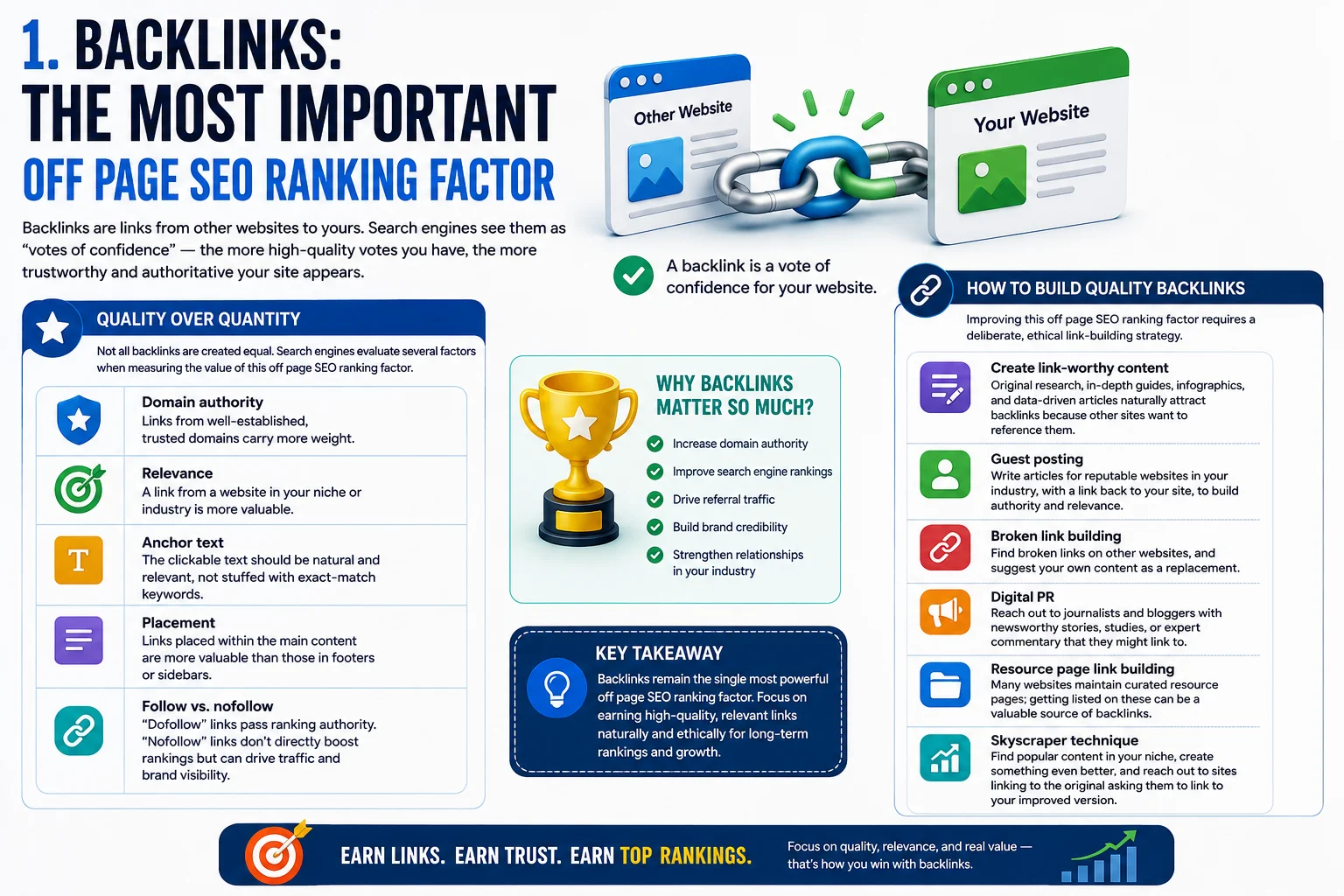
If there is one off page SEO ranking factor that stands above all others, it’s backlinks. A backlink is simply a link from another website pointing to yours. Search engines interpret backlinks as “votes of confidence” — the more high-quality votes you have, the more trustworthy your site appears.
Quality Over Quantity
Not all backlinks are created equal. A single link from a highly authoritative site like a major news publication can be worth more than hundreds of links from low-quality or spammy websites. When evaluating this off page SEO ranking factor, search engines look at:
- Domain authority of the linking site — Links from well-established, trusted domains carry more weight.
- Relevance — A link from a website in your niche or industry is more valuable than one from an unrelated site.
- Anchor text — The clickable text used in the link should be natural and relevant, not stuffed with exact-match keywords.
- Placement — Links placed within the main content of a page are generally more valuable than those buried in footers or sidebars.
- Follow vs. nofollow — “Dofollow” links pass on ranking authority, while “nofollow” links do not directly boost rankings but can still drive traffic and brand visibility.
How to Build Quality Backlinks
Improving this off page SEO ranking factor requires a deliberate, ethical link-building strategy. Here are proven methods:
- Create link-worthy content. Original research, in-depth guides, infographics, and data-driven articles naturally attract backlinks because other sites want to reference them.
- Guest posting. Writing articles for reputable websites in your industry, with a link back to your site, is one of the most effective ways to strengthen this off page SEO ranking factor.
- Broken link building. Find broken links on other websites, and suggest your own content as a replacement.
- Digital PR. Reach out to journalists and bloggers with newsworthy stories, studies, or expert commentary that they might link to.
- Resource page link building. Many websites maintain curated resource pages; getting listed on these can be a valuable source of backlinks.
- Skyscraper technique. Find popular content in your niche, create something even better, and reach out to sites linking to the original asking them to link to your improved version.
Because backlinks remain the single most powerful off page SEO ranking factor, any serious SEO strategy should dedicate significant time and resources to earning them naturally and ethically.
2. Domain Authority and Trust Signals
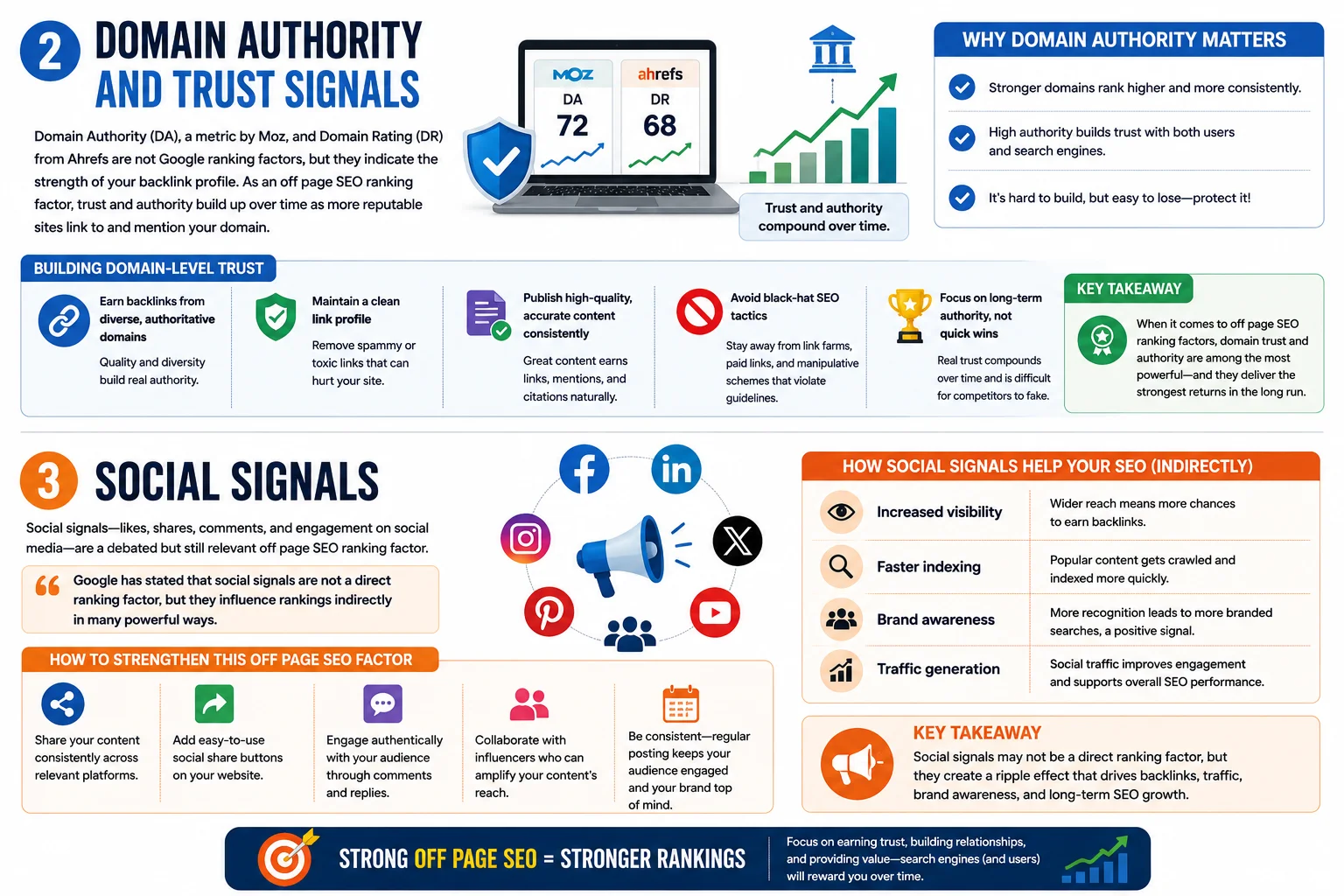
Domain Authority (DA), a metric developed by Moz, along with similar metrics like Domain Rating (DR) from Ahrefs, are not official Google ranking factors, but they are useful indicators of how strong your overall backlink profile is. As an off page SEO ranking factor, trust and authority accumulate gradually as more reputable sites link to and mention your domain.
Building domain-level trust involves:
- Earning backlinks from diverse, authoritative domains
- Maintaining a clean link profile free of spammy or manipulative links
- Consistently publishing high-quality, accurate content that others want to cite
- Avoiding black-hat SEO tactics like link farms or paid link schemes that violate search engine guidelines
When people ask which off page SEO ranking factors matter most for long-term growth, domain trust and authority almost always top the list, because they compound over time and are difficult for competitors to fake.
3. Social Signals
Social signals — likes, shares, comments, and overall engagement on social media platforms — are a debated but still relevant off page SEO ranking factor. While Google has stated that social signals are not a direct ranking factor, there is strong evidence that they contribute indirectly.
Here’s how social signals influence your rankings as an off page SEO ranking factor:
- Increased visibility. Content shared widely on social media reaches more people, increasing the chances of earning backlinks.
- Faster indexing. Actively shared content often gets crawled and indexed more quickly by search engines.
- Brand awareness. A strong social media presence builds recognition, which can lead to more branded searches — another positive signal.
- Traffic generation. Social media traffic supplements organic traffic and can improve overall site engagement metrics.
To strengthen this off page SEO ranking factor, focus on:
- Sharing your content consistently across relevant platforms (Facebook, LinkedIn, X/Twitter, Instagram, Pinterest, etc.)
- Encouraging social sharing with easy-to-use share buttons on your website
- Engaging authentically with your audience through comments and replies
- Collaborating with influencers who can amplify your content’s reach
4. Brand Mentions (Even Without Links)
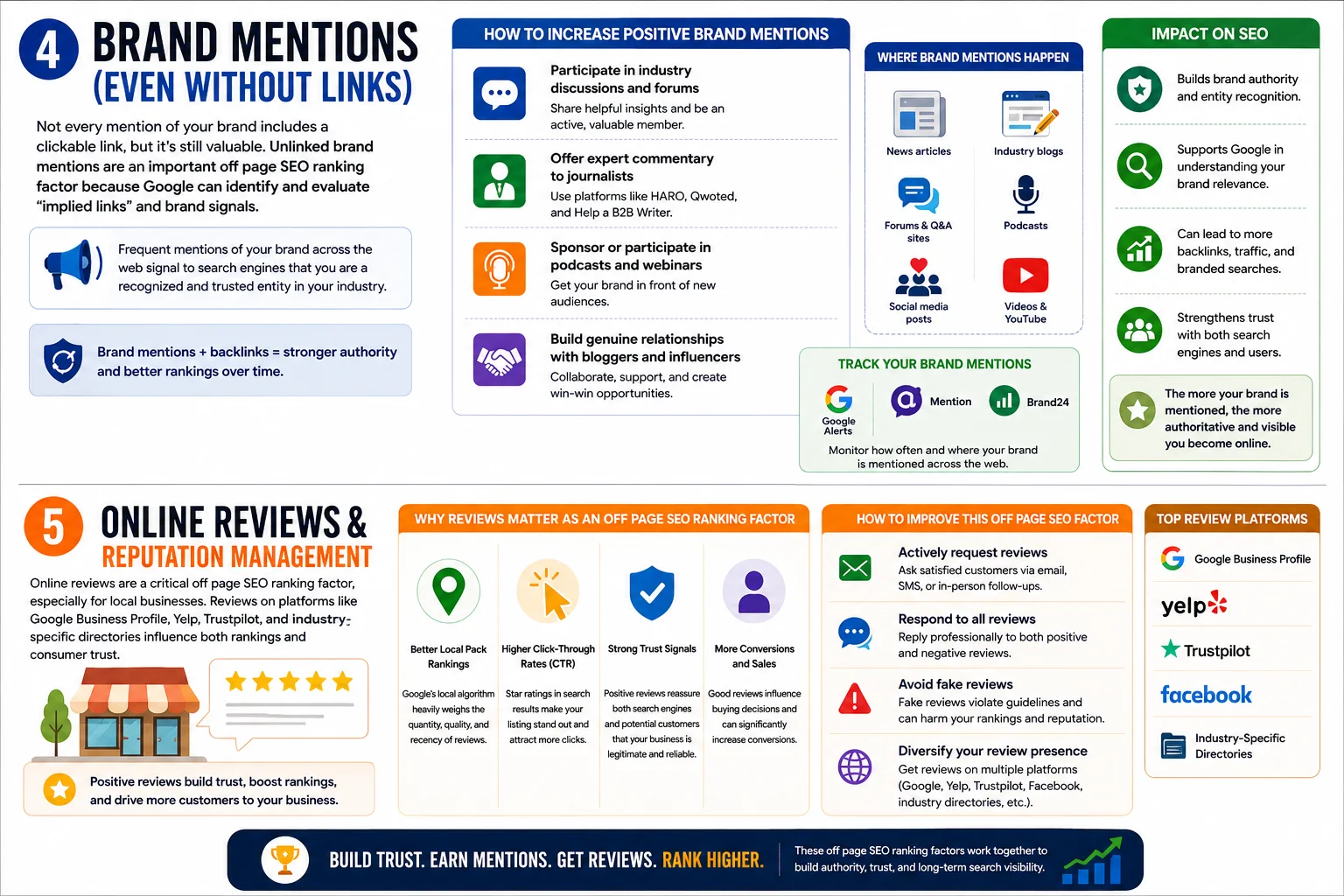
Not every mention of your brand online includes a clickable link, but that doesn’t mean it’s worthless. Unlinked brand mentions are increasingly recognized as an off page SEO ranking factor, especially since Google has patents related to identifying and evaluating “implied links.”
When your brand is mentioned frequently across the web — in articles, forums, podcasts, or social posts — it signals to search engines that you are a recognized entity in your industry. This off page SEO ranking factor works alongside traditional backlinks to build a fuller picture of your brand’s authority.
To increase positive brand mentions:
- Participate in industry discussions and forums
- Offer expert commentary to journalists (HARO and similar platforms can help)
- Sponsor or participate in podcasts and webinars
- Build genuine relationships with bloggers and influencers in your niche
Tools like Google Alerts, Mention, or Brand24 can help you track how often and where your brand is mentioned, allowing you to monitor this off page SEO ranking factor over time.
5. Online Reviews and Reputation Management
Online reviews are a critical off page SEO ranking factor, particularly for local businesses. Reviews on platforms like Google Business Profile, Yelp, Trustpilot, and industry-specific directories influence both rankings and consumer trust.
Why Reviews Matter as an Off Page SEO Ranking Factor
- Local pack rankings. Google’s local search algorithm heavily weighs the quantity, quality, and recency of reviews.
- Click-through rates. Star ratings appearing in search results can significantly increase the likelihood that users click on your listing.
- Trust signals. A steady stream of positive reviews reassures both search engines and potential customers that your business is legitimate and reliable.
How to Improve This Off Page SEO Ranking Factor
- Actively request reviews from satisfied customers through email or SMS follow-ups
- Respond professionally to both positive and negative reviews
- Avoid fake reviews, which can lead to penalties and loss of trust
- Diversify your review presence across multiple platforms, not just one
6. Guest Blogging and Content Syndication
Guest blogging remains one of the most reliable off page SEO ranking factors when done correctly. By contributing valuable content to other reputable websites, you can earn backlinks, expand your audience, and establish yourself as an authority in your field.
Content syndication — republishing your content on other platforms like Medium or industry publications — can also extend your reach, though it should be done carefully to avoid duplicate content issues. Always use canonical tags when syndicating content to indicate the original source.
Best practices for guest blogging as an off page SEO ranking factor:
- Target websites that are relevant to your niche and have genuine audiences
- Focus on providing real value rather than stuffing articles with links
- Avoid low-quality guest posting networks that exist purely for link manipulation
- Build long-term relationships with editors and site owners rather than one-off transactions
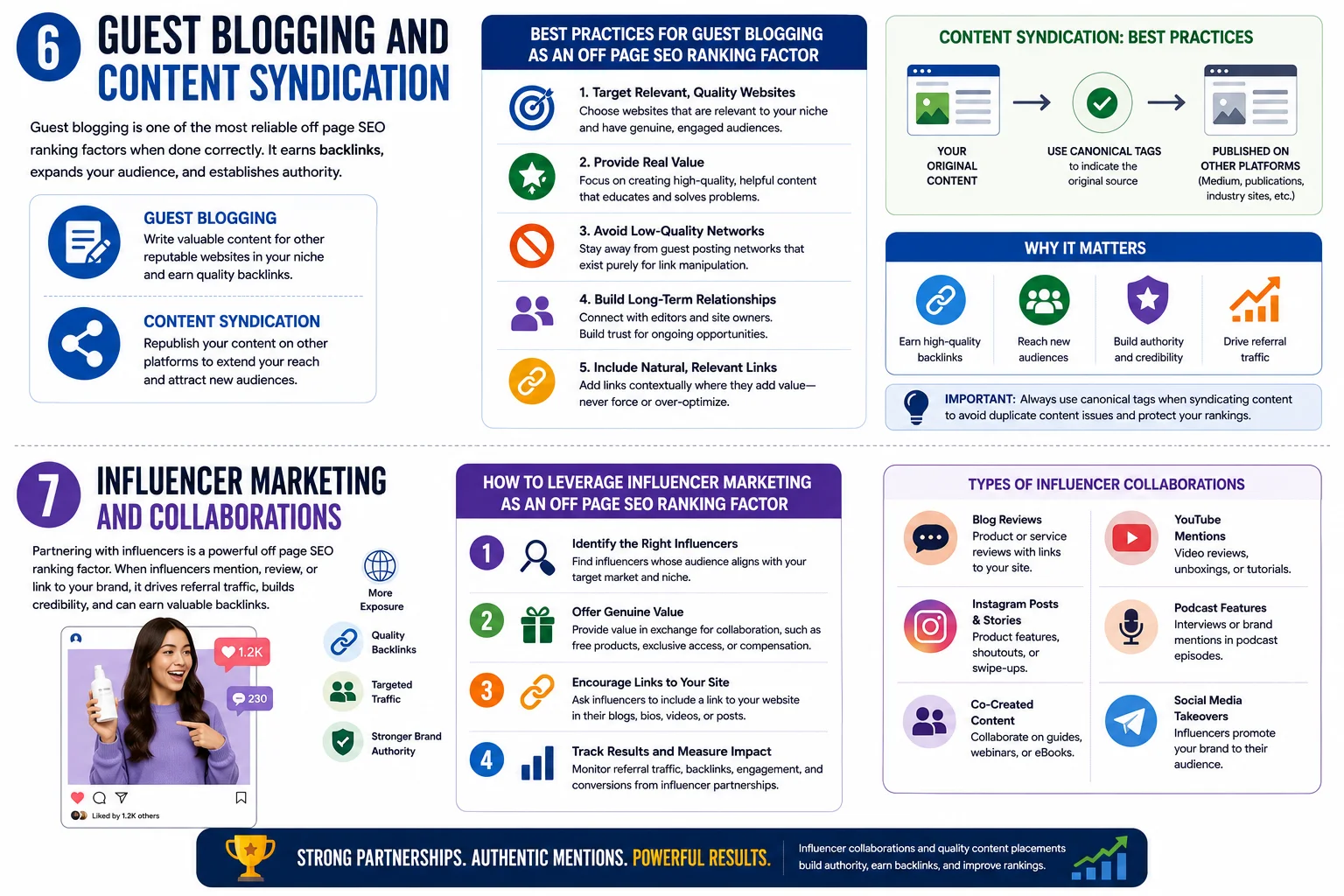
7. Influencer Marketing and Collaborations
Partnering with influencers has become an increasingly important off page SEO ranking factor, especially in industries like fashion, health, technology, and lifestyle. When influencers mention, review, or link to your brand, it can drive significant referral traffic and often results in valuable backlinks.
To leverage influencer marketing as an off page SEO ranking factor:
- Identify influencers whose audience aligns with your target market
- Offer genuine value in exchange for collaboration, such as free products or exclusive access
- Encourage influencers to link back to your website in their content
- Track the referral traffic and backlinks generated from these partnerships
8. Local Citations and NAP Consistency
For businesses targeting local customers, local citations are an essential off page SEO ranking factor. A citation is any online mention of your business’s Name, Address, and Phone number (NAP), typically found in online directories, social platforms, and review sites.
Consistency is key here. If your NAP information varies across different platforms, it can confuse search engines and hurt your local rankings. To strengthen this off page SEO ranking factor:
- Ensure your NAP details are identical across all directories and platforms
- List your business on major directories like Google Business Profile, Bing Places, Yelp, and industry-specific listings
- Regularly audit your citations to catch and correct inconsistencies
- Claim and optimize your Google Business Profile with accurate categories, hours, and photos
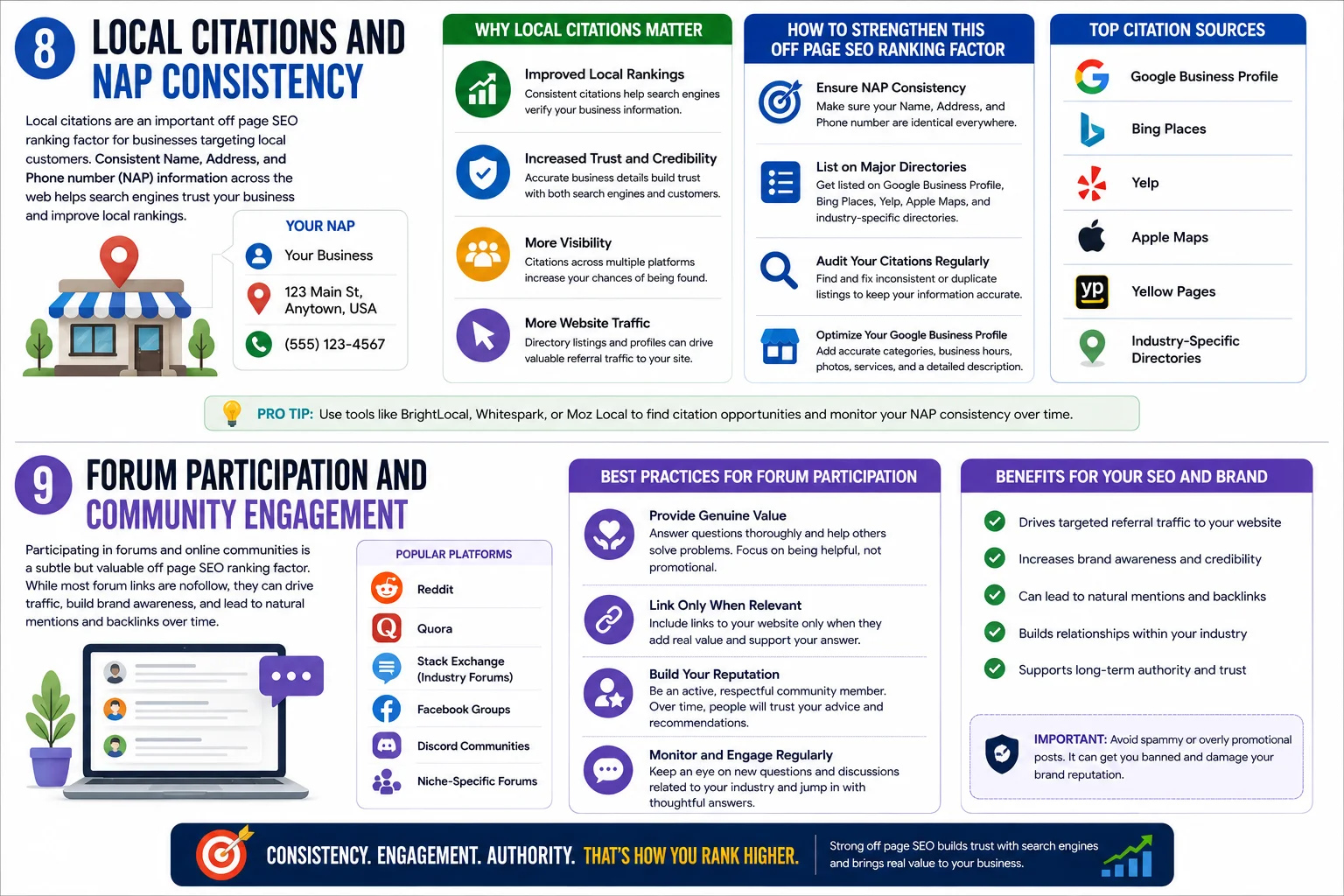
9. Forum Participation and Community Engagement
Engaging in forums like Reddit, Quora, and niche-specific communities can serve as a subtle but meaningful off page SEO ranking factor. While many forum links are nofollow and don’t pass direct ranking authority, the traffic, brand exposure, and potential for organic mentions make this activity worthwhile.
To use forum participation effectively:
- Provide genuinely helpful answers rather than promotional content
- Include links only when they add real value to the discussion
- Build a reputation as a knowledgeable community member over time
- Monitor questions related to your industry and respond thoughtfully
10. Social Bookmarking and Content Curation Sites
Social bookmarking sites like Reddit, Digg, and specialized industry curation platforms can contribute to your off page SEO ranking factor profile by driving referral traffic and occasionally earning backlinks from users who discover and share your content further.
While the direct SEO value of bookmarking sites has diminished over the years due to spam abuse, they can still play a supporting role when used strategically and not as a primary link-building tactic.
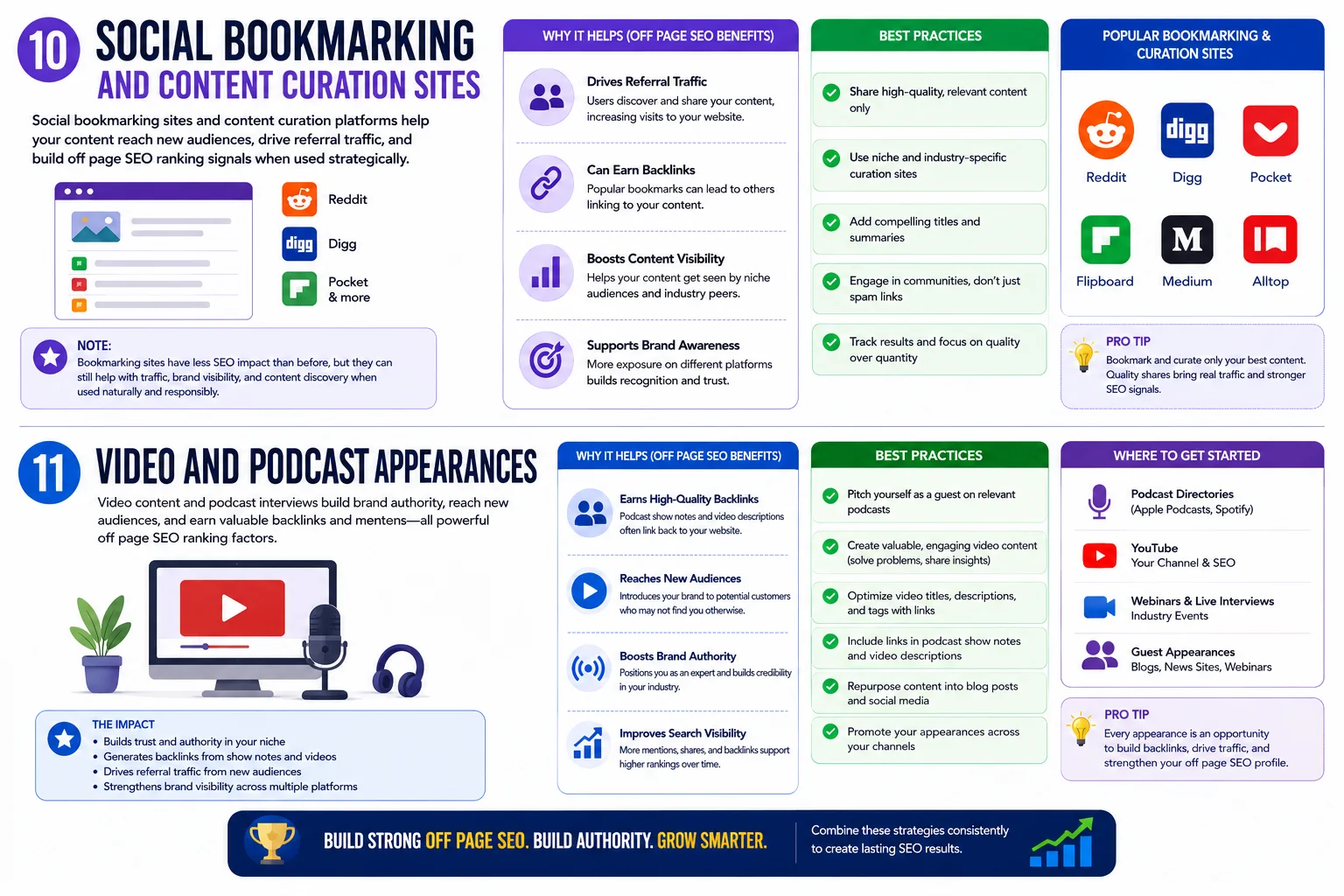
11. Video and Podcast Appearances
Appearing as a guest on podcasts or creating video content for platforms like YouTube is a growing off page SEO ranking factor. These appearances often come with backlinks in show notes or video descriptions, plus exposure to new audiences who may later link to or mention your website.
To maximize this off page SEO ranking factor:
- Pitch yourself as a guest expert on podcasts relevant to your industry
- Optimize video descriptions with links back to your website
- Repurpose video and audio content into blog posts, further supporting your content marketing efforts
- Share these appearances across your own social channels to amplify reach
12. Content Marketing’s Role in Off Page SEO
While content marketing is often categorized under on-page SEO, its ripple effects heavily influence off page SEO ranking factors. High-quality, shareable content is the foundation that makes link building, social sharing, and brand mentions possible in the first place.
Content types that tend to generate the strongest off page SEO ranking factor benefits include:
- Original research and data studies — Journalists and bloggers love citing statistics
- Comprehensive guides — In-depth resources naturally attract links over time
- Infographics — Visual content is highly shareable and often embedded with attribution links
- Case studies — Real-world results build credibility and are frequently referenced by others
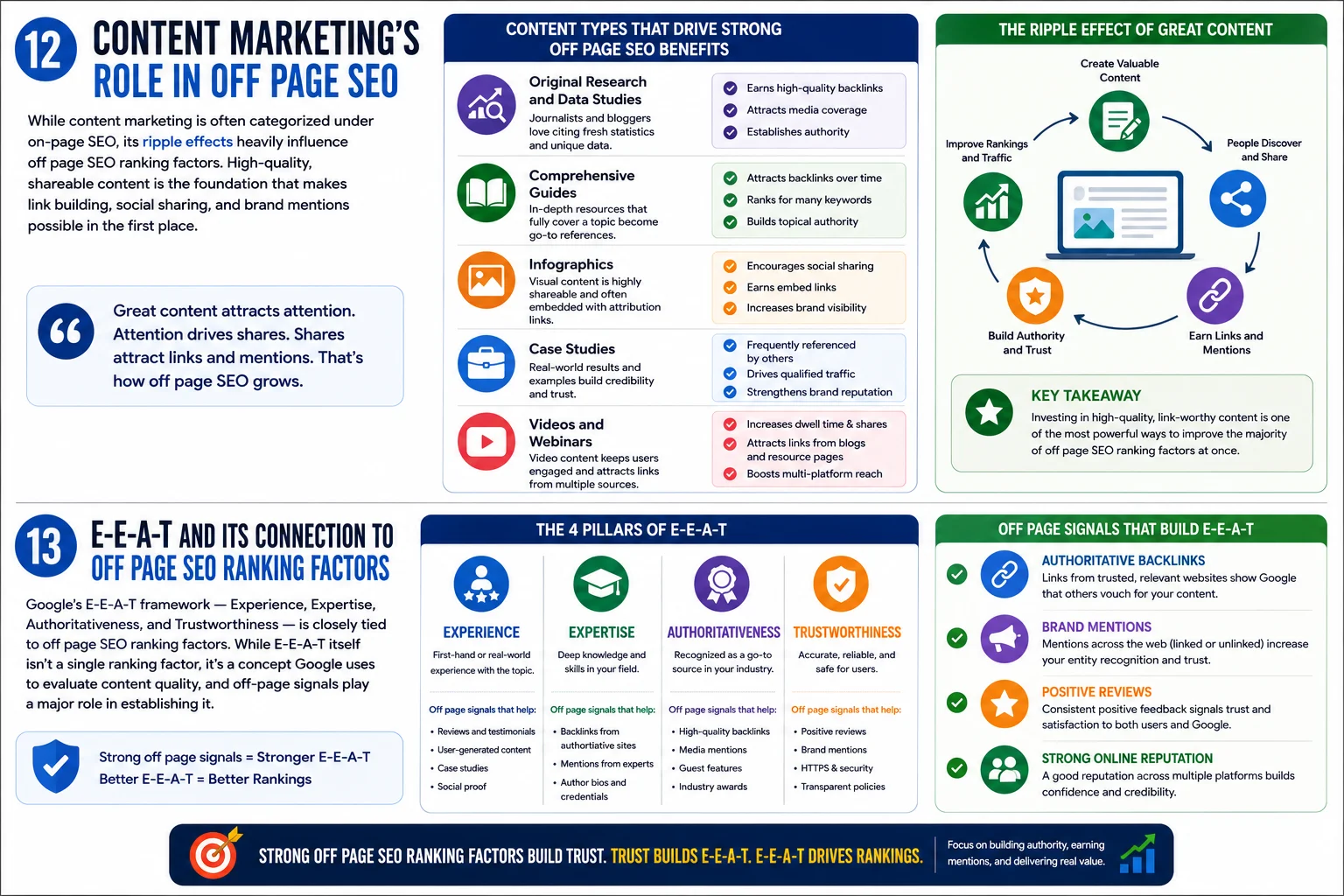
13. E-E-A-T and Its Connection to Off Page SEO Ranking Factors
Google’s E-E-A-T framework — Experience, Expertise, Authoritativeness, and Trustworthiness — is closely tied to off page SEO ranking factors. While E-E-A-T itself isn’t a single ranking factor, it’s a concept Google uses to evaluate content quality, and off-page signals play a major role in establishing it.
Backlinks from authoritative sources, mentions from recognized experts, positive reviews, and a strong online reputation all contribute to how search engines assess your E-E-A-T. Essentially, strengthening your off page SEO ranking factors directly supports your site’s perceived expertise and trustworthiness.
Common Mistakes to Avoid With Off Page SEO Ranking Factors
Even experienced marketers can make mistakes when working on off page SEO ranking factors. Avoid these common pitfalls:
- Buying links. Purchasing backlinks violates Google’s guidelines and can result in manual penalties.
- Over-optimizing anchor text. Using the exact same keyword-rich anchor text repeatedly looks unnatural and can trigger algorithmic scrutiny.
- Ignoring link relevance. Links from completely unrelated industries provide little value and can sometimes look spammy.
- Neglecting reviews. Failing to respond to negative reviews can damage both reputation and local rankings.
- Chasing quantity over quality. A handful of high-authority backlinks will always outperform hundreds of low-quality ones.
- Inconsistent NAP data. Sloppy local citations confuse search engines and hurt local SEO performance.
- Ignoring social media entirely. While not a direct ranking factor, skipping social media means missing out on valuable indirect benefits.
How to Measure the Success of Your Off Page SEO Ranking Factors
Tracking progress is essential to understanding whether your efforts on off page SEO ranking factors are paying off. Key metrics to monitor include:
- Number and quality of referring domains — Tools like Ahrefs, SEMrush, and Moz can help track this.
- Domain Authority/Domain Rating trends — Watch for gradual increases over time.
- Referral traffic — Analyze how much traffic is coming from backlinks and social shares via Google Analytics.
- Branded search volume — An increase in searches for your brand name often indicates growing awareness driven by off page efforts.
- Review quantity and average rating — Track this across all major review platforms.
- Social engagement metrics — Shares, comments, and mentions across social platforms.
Regularly auditing these metrics will help you understand which off page SEO ranking factors are working best for your specific website and industry, allowing you to allocate your time and budget more effectively.
Building a Sustainable Off Page SEO Strategy
Improving your off page SEO ranking factors isn’t a one-time task — it’s an ongoing process that requires consistency, patience, and ethical practices. Here’s a simple framework to keep your strategy on track:
- Audit your current backlink profile. Understand where you stand before setting goals.
- Set clear, measurable goals. Define what success looks like for each off page SEO ranking factor you’re targeting.
- Create a content calendar focused on link-worthy assets. Plan original research, guides, and visual content designed to attract natural backlinks.
- Build relationships, not just links. Networking with journalists, bloggers, and influencers pays off far beyond a single backlink.
- Monitor and adjust. Use analytics tools to track which tactics are producing the best results and refine your approach accordingly.
- Stay updated on algorithm changes. Google frequently updates how it evaluates off page SEO ranking factors, so staying informed helps you avoid outdated or risky tactics.
Off Page SEO Ranking Factors vs. On-Page SEO: Understanding the Difference
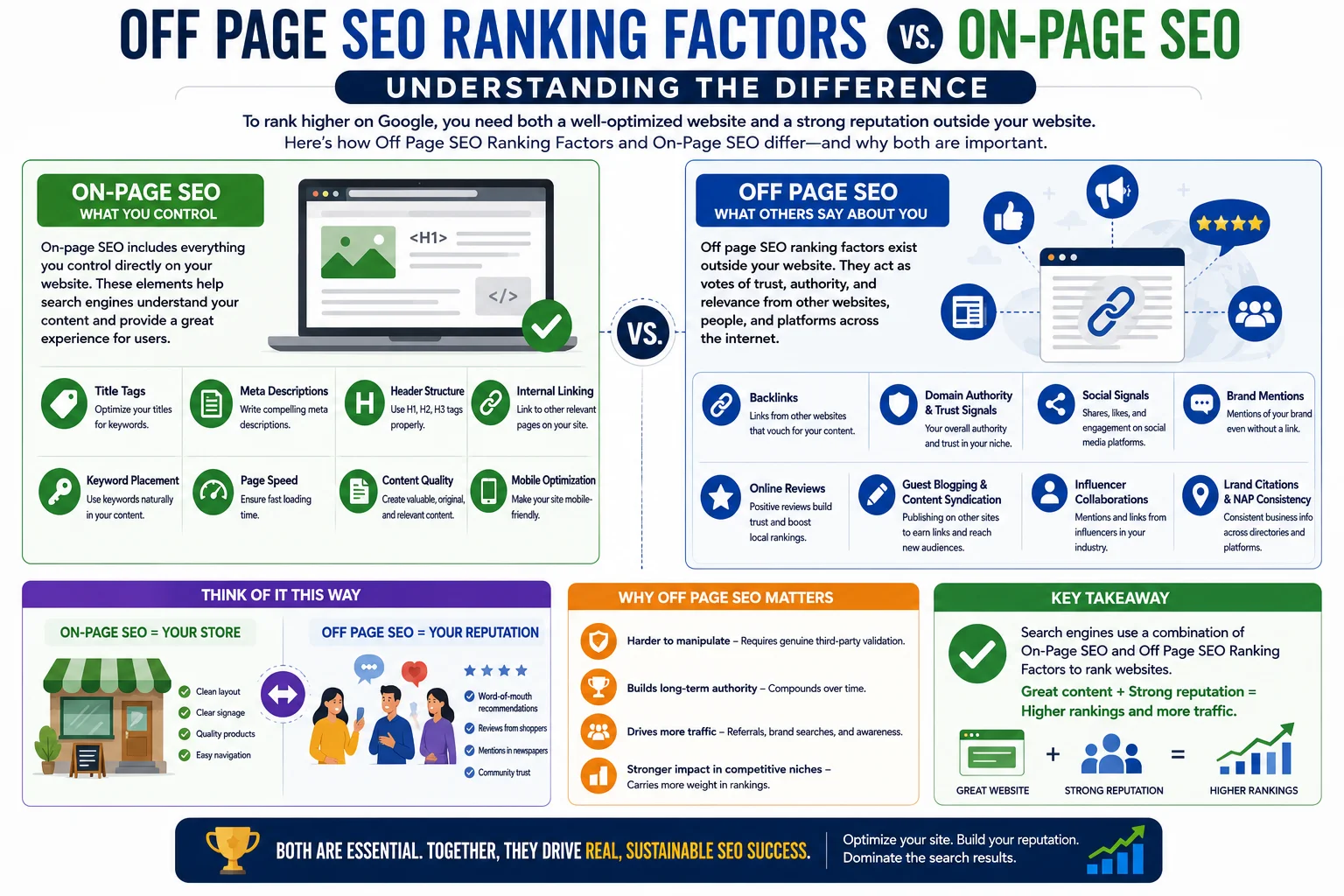
To fully appreciate why off page SEO ranking factors deserve so much attention, it helps to understand how they differ from on-page SEO. On-page SEO includes everything you control directly on your website: title tags, meta descriptions, header structure, internal linking, keyword placement, page speed, and content quality. Off page SEO ranking factors, on the other hand, live outside your website entirely.
Think of on-page SEO as building a great store — clean layout, clear signage, quality products. Off page SEO ranking factors are more like your store’s reputation in the community: word-of-mouth recommendations, reviews from other shoppers, and mentions in the local newspaper. A great store with no reputation will struggle to attract customers, just as a well-optimized website with weak off page SEO ranking factors will struggle to rank, no matter how good the content is.
Search engines use a combination of both to rank websites, but because off page SEO ranking factors are harder to manipulate at scale and require genuine third-party validation, they often carry disproportionate weight in competitive niches. This is precisely why SEO professionals dedicate entire strategies solely to improving off page SEO ranking factors, separate from their content and technical SEO efforts.
Industry-Specific Considerations for Off Page SEO Ranking Factors
Different industries require different approaches to off page SEO ranking factors. What works for an e-commerce store may not work as well for a B2B software company or a local service business. Here’s how the approach can vary:
E-commerce Websites
For online stores, off page SEO ranking factors often center around product reviews, influencer unboxing videos, affiliate partnerships, and mentions on comparison or “best of” list websites. Building relationships with bloggers who write gift guides or product roundups can be an especially effective way to earn backlinks and drive sales simultaneously.
B2B and SaaS Companies
For B2B and software companies, off page SEO ranking factors tend to revolve around thought leadership. Publishing original research, contributing to industry publications, speaking at webinars, and earning mentions in analyst reports (like Gartner or G2 reviews) all strengthen authority in ways that resonate with a professional audience.
Local Service Businesses
Local businesses, such as plumbers, dentists, or restaurants, should prioritize off page SEO ranking factors like local citations, Google Business Profile optimization, and customer reviews. Since local search results weigh proximity and reputation heavily, these off page SEO ranking factors often matter more than traditional backlinks for businesses serving a specific geographic area.
Content Publishers and Blogs
For content-driven websites, off page SEO ranking factors are largely driven by content quality and shareability. Original journalism, unique data studies, and expert interviews tend to generate the strongest natural backlink profiles because other publishers want to reference credible, original sources.
Tools to Help You Track and Improve Off Page SEO Ranking Factors
Numerous tools can help you monitor and strengthen your off page SEO ranking factors. Here are some of the most widely used:
- Ahrefs — One of the most comprehensive tools for backlink analysis, competitor research, and tracking Domain Rating over time.
- SEMrush — Offers backlink auditing, brand monitoring, and link-building outreach features.
- Moz Link Explorer — Provides Domain Authority scores and spam score analysis to help evaluate the quality of your backlink profile.
- Google Search Console — A free tool that shows which external sites are linking to you and how your site performs in search results.
- BuzzSumo — Useful for identifying which content performs best on social media and who is sharing it, helping guide content marketing strategy.
- Google Alerts — A free way to monitor brand mentions across the web in real time.
- Whitespark or BrightLocal — Excellent for managing local citations and tracking NAP consistency across directories.
Using a combination of these tools allows you to get a complete picture of where your off page SEO ranking factors currently stand and where the biggest opportunities for improvement lie.
A Sample 90-Day Action Plan for Off Page SEO Ranking Factors
If you’re unsure where to start, here is a simplified roadmap for improving your off page SEO ranking factors over a 90-day period:
Days 1–30: Foundation and Audit
- Conduct a full backlink audit using Ahrefs or SEMrush
- Clean up inconsistent NAP citations across directories
- Claim and fully optimize your Google Business Profile
- Set up Google Alerts and brand monitoring tools
Days 31–60: Outreach and Content Creation
- Identify 20–30 relevant websites for guest posting opportunities
- Create at least one high-quality, link-worthy content asset (original research, guide, or infographic)
- Begin outreach to journalists and bloggers using digital PR tactics
- Start actively requesting reviews from recent customers
Days 61–90: Scale and Optimize
- Expand guest posting and digital PR outreach based on early results
- Analyze which off page SEO ranking factors are producing the best ROI
- Double down on the highest-performing tactics
- Continue monitoring brand mentions, reviews, and referral traffic monthly
Following a structured plan like this ensures that your efforts toward improving off page SEO ranking factors remain consistent and measurable, rather than sporadic and difficult to evaluate.
Frequently Asked Questions About Off Page SEO Ranking Factors
Are off page SEO ranking factors more important than on-page SEO? Neither should be ignored. On-page SEO ensures your website is properly structured and optimized for search engines to understand, while off page SEO ranking factors build the trust and authority needed to outrank competitors. A balanced strategy addresses both.
How long does it take to see results from improving off page SEO ranking factors? Because off page SEO ranking factors like backlinks and domain authority build gradually, most websites see meaningful improvements within three to six months of consistent effort, though highly competitive niches may take longer.
Can too many backlinks hurt my rankings? It’s not the quantity but the quality and naturalness of your link profile that matters. A sudden, unnatural spike in low-quality backlinks can actually harm your off page SEO ranking factors and trigger algorithmic scrutiny.
Do social media signals directly affect off page SEO ranking factors? Not directly, according to Google, but the indirect benefits — increased visibility, more backlink opportunities, and higher branded search volume — make social media an important supporting piece of your overall off page SEO ranking factor strategy.
What is the fastest way to improve off page SEO ranking factors? There is no true shortcut, but creating genuinely valuable, original content and proactively reaching out to relevant websites and journalists tends to produce the fastest sustainable results among all off page SEO ranking factors.
A Quick Checklist for Strengthening Off Page SEO Ranking Factors
Before wrapping up, here’s a condensed checklist you can return to whenever you want to review your progress on off page SEO ranking factors:
- [ ] Audit your backlink profile and remove or disavow toxic links
- [ ] Identify and pursue guest posting opportunities on relevant, authoritative sites
- [ ] Publish at least one piece of original, link-worthy content per quarter
- [ ] Claim and fully optimize your Google Business Profile and other local directories
- [ ] Keep NAP information consistent across every citation source
- [ ] Actively request and respond to customer reviews
- [ ] Monitor brand mentions and follow up on unlinked mentions when appropriate
- [ ] Share content consistently across relevant social media platforms
- [ ] Build genuine relationships with journalists, bloggers, and influencers in your niche
- [ ] Track referring domains, Domain Authority, and referral traffic monthly
Working through this checklist regularly will help ensure that none of the major off page SEO ranking factors are being neglected, and that your efforts remain balanced across backlinks, reputation, local presence, and community engagement.
Final Thoughts on Off Page SEO Ranking Factors
Mastering off page SEO ranking factors is essential for any website that wants to compete in today’s search landscape. While on-page SEO lays the foundation, it’s the accumulation of backlinks, social signals, brand mentions, reviews, and community engagement that truly builds long-term authority and trust in the eyes of search engines.
By focusing on ethical, sustainable strategies — creating link-worthy content, fostering genuine relationships, managing your online reputation, and staying consistent with local citations — you can steadily strengthen your website’s off page SEO ranking factors and see meaningful improvements in your search rankings over time.
Remember, off page SEO is a marathon, not a sprint. The websites that dominate search results today didn’t get there overnight; they built their authority gradually through consistent effort on the off page SEO ranking factors outlined in this guide. Start applying these strategies today, and you’ll be well on your way to building a website that search engines — and users — trust.